

Horsehide Leather & Teacore Dye Explained: A Deep Dive Featuring The Flat Head FN-LJ-HW004
Horsehide Leather and Teacore Dye, Explained — With a Full Spec Breakdown of The Flat Head FN-LJ-HW004
Why horsehide became the material of choice for motorcycle jackets, how "teacore" (茶芯 / chashin) dyeing actually works, and what it means for the way a jacket like The Flat Head's FN-LJ-HW004 fades over years of wear — with official specs, sizing, and aging photos straight from The Flat Head.

In a market flooded with "vintage-inspired" leather jackets, only a small handful of pieces actually earn a comparison to a real 1940s Buco or Harley Davidson horsehide. That reputation almost always comes down to two things: the leather itself, and how it's dyed. Horsehide and teacore finishing are the two ingredients that separate a jacket built to be lived in for decades from one built to look good in a single photo. Below, we get into why horsehide behaves the way it does, how teacore dye actually works, how the effect shows up differently across makers like Real McCoy's, Himel Bros, Red Wing, and Sagara — and then zoom in on the current standard-bearer for the style, The Flat Head's FN-LJ-HW004 double rider's jacket, which we're proud to carry at Private & Co., drawing on both the brand's own spec sheet and aging archive and our own listing.
Why Horsehide Leather Is Still the Gold Standard
Horsehide has a reputation problem before people ever touch it — it sounds like a novelty compared to cowhide. In practice, it's the opposite. Horse hides, particularly the "shell" cut from the rump, have a denser, tighter fiber structure than cattle hide, because horses simply have less loose, stretchy skin across their body. That tighter grain is what gives horsehide its two signature traits: a slightly stiff, almost armor-like hand when new, and an exceptional resistance to creasing, stretching out, and general wear.
This is exactly why horsehide became the material of choice for American motorcycle jackets in the 1930s and '40s. Brands like Buco needed something that could take repeated abrasion against a bike seat and asphalt without collapsing. Horsehide also breaks in unlike anything else. Because the surface is denser, it doesn't wrinkle into deep, soft folds the way lambskin or soft cowhide does — instead it develops sharp, defined creases at the elbows and pocket edges, the kind of crisp wear pattern collectors specifically chase.
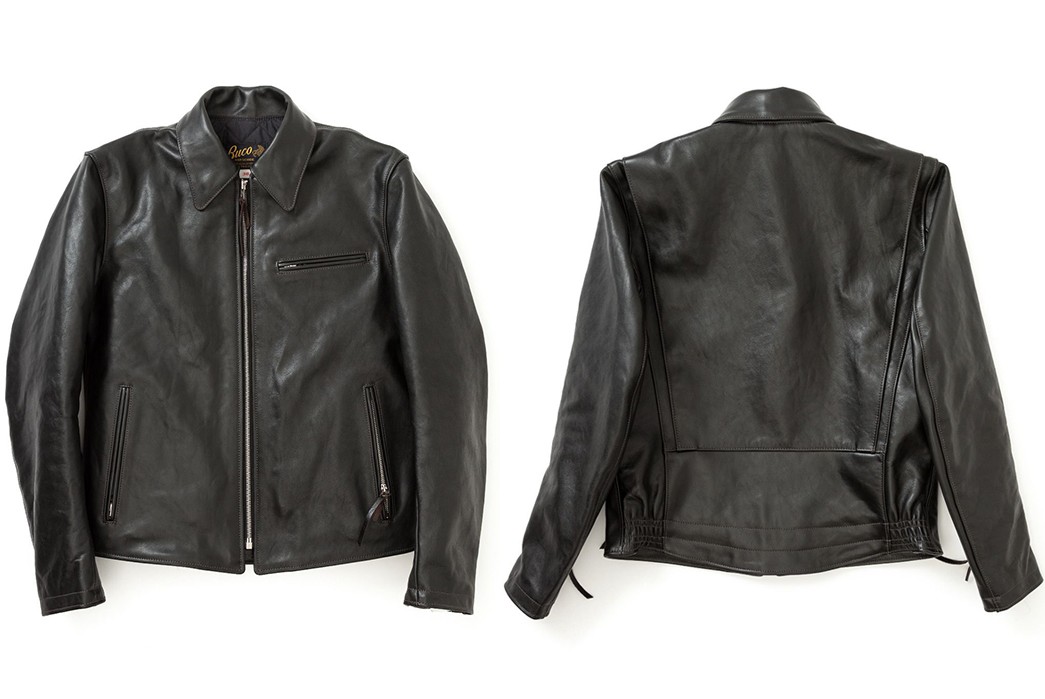
The Flat Head sources its horsehide from Shinki Hikaku, a long-established tannery in Himeji, Japan, widely regarded as the finest horsehide producer left in the world. Shinki still vegetable-tans its hides the slow way, soaking them in tannin baths for weeks rather than chrome-tanning in hours, and much of its raw horsehide stock is sourced from Europe. It's genuinely small-batch material, and Shinki's teacore horsehide specifically shows up throughout the heritage leather world beyond The Flat Head — in Real McCoy's Buco reproductions and Viberg's service boots, among others.
What Is Teacore Dye, Exactly?
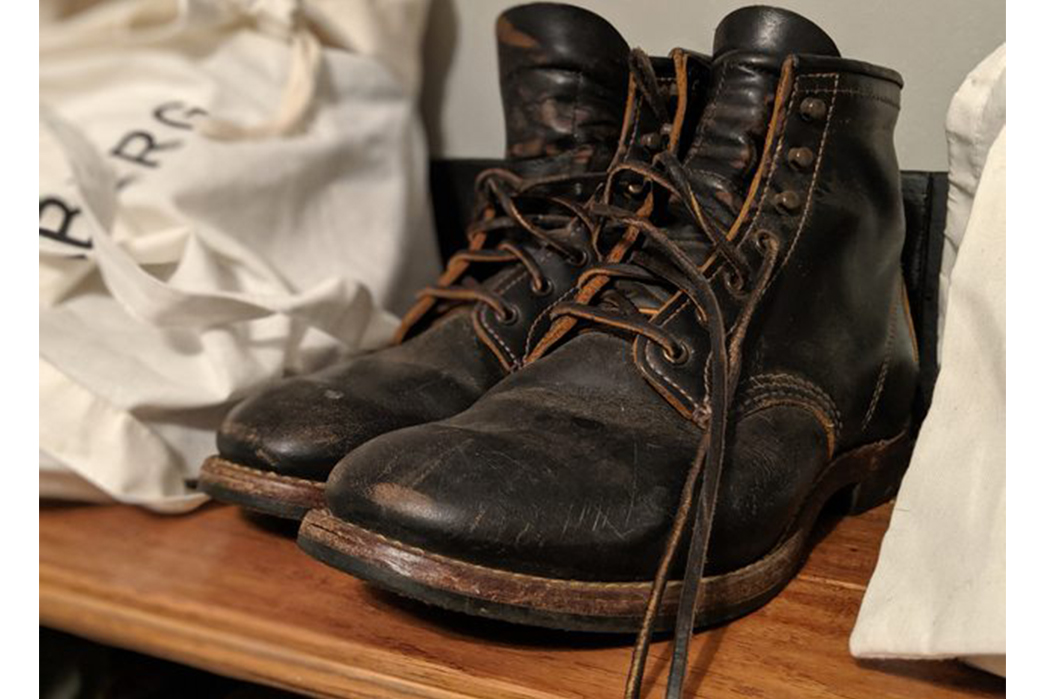
Teacore — called 茶芯 (chashin) in Japanese, literally "tea core" — refers to leather with two distinct layers of color: a dark, usually black, top coat, and a lighter tan-brown core underneath that only becomes visible as the top layer wears away. It's not a print or an illusion; it's a genuine byproduct of how the hide is tanned and finished.
Real teacore starts at the tanning stage. The hide is vegetable-tanned using bark tannins, which naturally stain it a warm pinkish-brown. That brown is the "core," baked into the fiber of the leather itself rather than applied afterward. Over top of that, a black or dark semi-aniline finish is applied: a hybrid of dye and pigment, with enough pigment for solid, even coverage and real durability, but light enough that it sits closer to the surface rather than sealing the leather in a plastic-like paint layer the way a heavy pigment finish would.
Because that top layer is thin and only semi-penetrating, it's not built to survive years of flexing, rubbing, and sun exposure unscathed — and that's the point. As a teacore jacket or boot is worn, the dark finish flakes, scuffs, and rubs thin at every point of contact: elbows, cuffs, pocket edges, wherever a strap or a saddle sits against it. Underneath, the brown veg-tan core starts to show through, and no two pieces fade the same way twice, because no two people wear, sit, and move in them identically.
"For the vintage guys, that's what they prefer... we can afford to customize and request custom pigment finishes that wear off a little bit and show the leather underneath." — Dave Himel, Himel Bros., on why higher-end brands intentionally use softer, wear-prone finishes for teacore leather.
It's also worth knowing that not all "teacore" on the market is created equal. Because chrome tanning is faster and cheaper than vegetable tanning, some tanneries take a chrome-tanned hide — which naturally comes out a grayish blue — and simply dye it brown before adding the black top coat, faking the effect rather than growing it out of the tannage itself. Genuine teacore, the kind found in Shinki horsehide, is generally a giveaway by price: real veg-tanning in Japan can run roughly ten times the cost per foot of chrome tanning done cheaply overseas, which is a large part of why jackets built from it aren't cheap.
Case Study: The Flat Head FN-LJ-HW004 — Full Specs
With the background out of the way, here's how all of this comes together in one specific piece: The Flat Head's FN-LJ-HW004, a Japanese-made double rider's jacket that's become a benchmark for what teacore horsehide can look like when it's executed at the highest level. The details below combine The Flat Head's own product page (translated from Japanese) with our listing at Private & Co.

Front and back, as listed at Private & Co.
- Model: The Flat Head FN-LJ-HW004 — Horsehide Double Riders Jacket (ホースハイド ダブルライダースジャケット)
- Leather: 1.3mm thick horsehide, full vegetable tanning, tanned by Shinki Hikaku (新喜皮革), Japan
- Finish: Semi-aniline / teacore (セミアニリン・茶芯)
- Lining: Red rayon kersey (レーヨンカルゼ)
- Zippers: Universal Zipper throughout — bell-shaped pulls on the front and D-pocket, with a matching horsehide pull tab; a diamond-link chain zipper on the left chest pocket
- Buckle: Iron-punched FH buckle, brass-toned paint over iron (the paint wears through with age to reveal the iron underneath)
- Hardware: Silver studs, FH original dot button
- Back panel: Action pleats (アクションプリーツ) for shoulder and arm mobility
- Shoulders: Epaulettes with silver studs that darken with age
- Color: Black
- Sizes: 36 (S) / 38 (M) / 40 (L) / 42 (XL) / 44 (XXL) / 46 (XXXL) / 48 (XXXXL)
- Made in: Japan
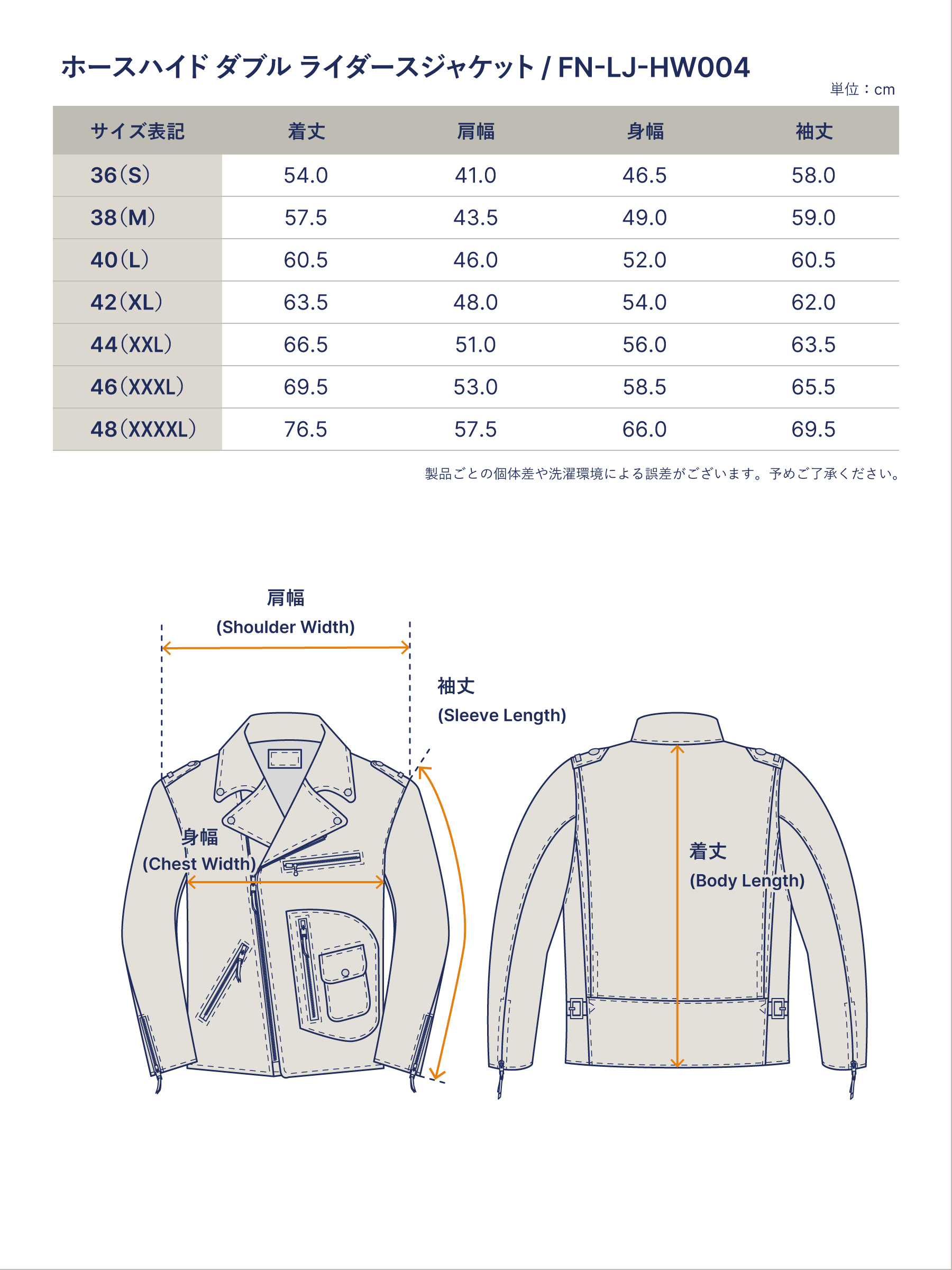
Official Size Chart (cm, garment measurements)
| Size | Length | Shoulder Width | Body Width (chest, flat) | Sleeve Length |
|---|---|---|---|---|
| 36 (S) | 54.0 | 41.0 | 46.5 | 58.0 |
| 38 (M) | 57.5 | 43.5 | 49.0 | 59.0 |
| 40 (L) | 60.5 | 46.0 | 52.0 | 60.5 |
| 42 (XL) | 63.5 | 48.0 | 54.0 | 62.0 |
| 44 (XXL) | 66.5 | 51.0 | 56.0 | 63.5 |
| 46 (XXXL) | 69.5 | 53.0 | 58.5 | 65.5 |
| 48 (XXXXL) | 76.5 | 57.5 | 66.0 | 69.5 |
Source: The Flat Head official size guide, flat-head.com. Body width is measured flat across the chest (roughly half of chest circumference). Individual pieces may vary slightly due to the handmade nature of each jacket.
Nine Details The Flat Head Builds Into Every FN-LJ-HW004
Straight from The Flat Head's own product notes, here's what the brand highlights as the defining details of the jacket:
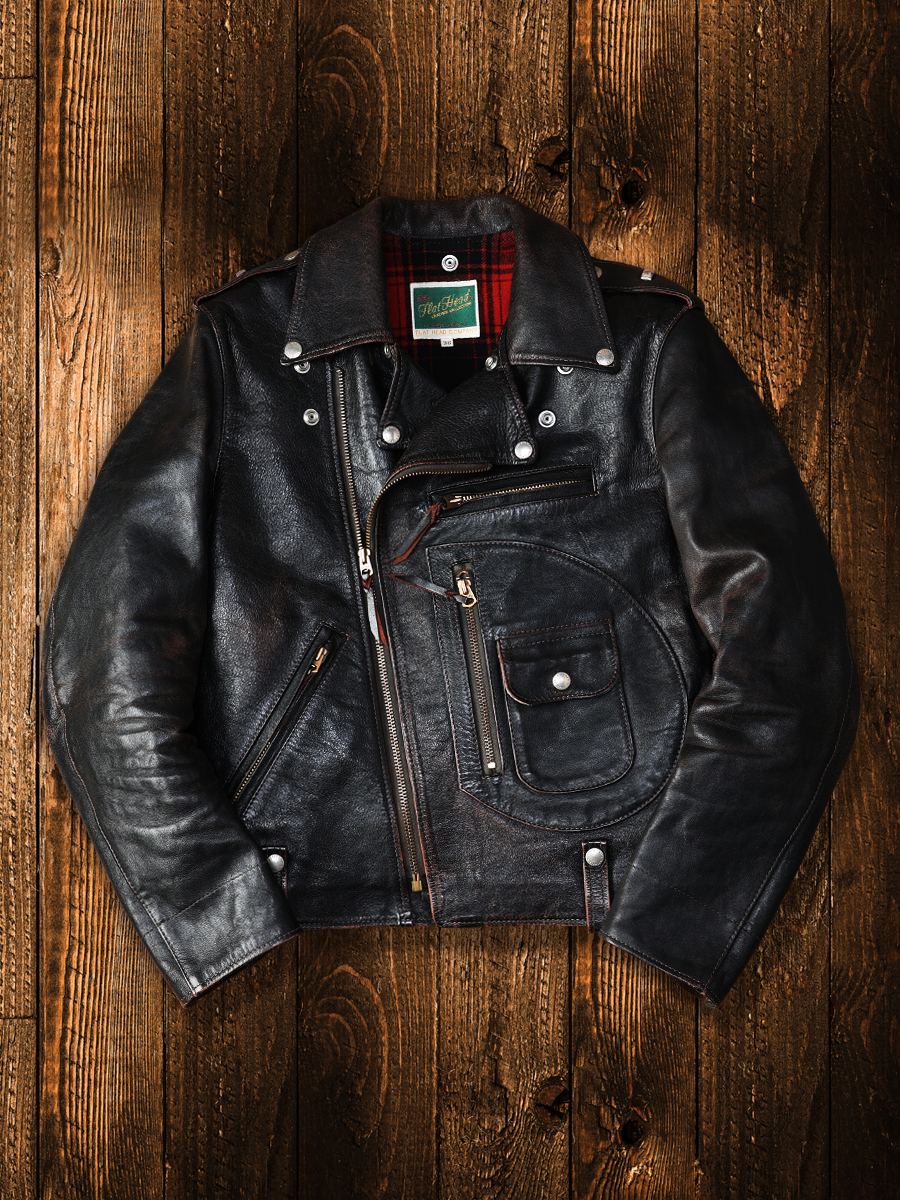
Semi-aniline horsehide developed with Shinki Hikaku. Fully vegetable-tanned horsehide has a distinctive firmness and softens to the body with wear. As the surface rubs, the brown core of the leather emerges — the aging effect known as chashin, or teacore.
A collar that opens wide on both sides at the chest, emphasizing the double rider's silhouette. When zipped, two layers of leather overlap at the front for real wind resistance — practical outerwear for riding.
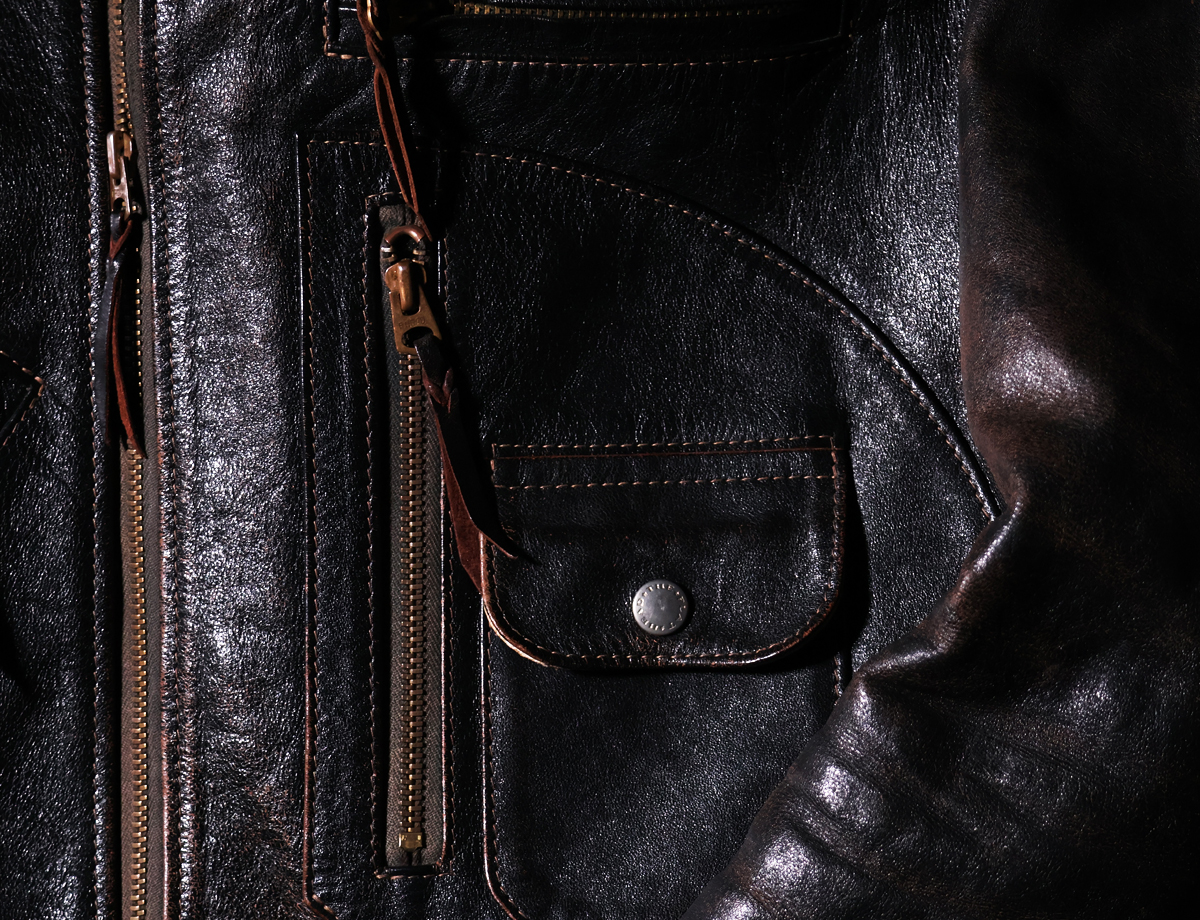
A large oval pocket at the abdomen, named for its resemblance to the letter D. The zipper opens wide, making it easy to reach in and out even while wearing gloves.
Bell-shaped pulls on the front and D-pocket, with a matching horsehide tab. The brass-toned hardware dulls gradually with age, aging in step with the leather itself.
A diamond-link chain zipper on the left chest pocket, matching the Universal Zipper hardware used throughout.
Adjustable hem buckles on both sides. They look like brass but are actually iron with a brass-colored paint finish — with wear, the paint rubs through to reveal the iron underneath.
A twill-woven rayon lining chosen for the strength and smooth slip it adds inside the jacket, plus the sheen and vivid color rayon is known for.
Pleats built into the back panel that expand for freedom of movement in the shoulders and arms — essential for a jacket meant to be worn on a bike.
Silver studded epaulettes on both shoulders. The studs darken and add character over time, aging in step with the jacket's teacore.
There's also a leather-piped interior pocket on the left panel, sized to fit a phone up to the wrist.


Construction and hardware detail, from our FN-LJ-HW004 listing at Private & Co.
What Makes This Kind of Fading So Special
Most "distressed" leather jackets fake this look with a pre-worn finish sprayed on at the factory — sanded edges, a uniform gray-brown wash meant to look old on day one. Genuine teacore horsehide does the opposite: it ships looking almost severe, in a deep, matte-flat black with a slightly stiff, structured hand. All of the character is earned later, through actual wear — and The Flat Head documents this better than almost anyone, through its own official Aging Gallery.
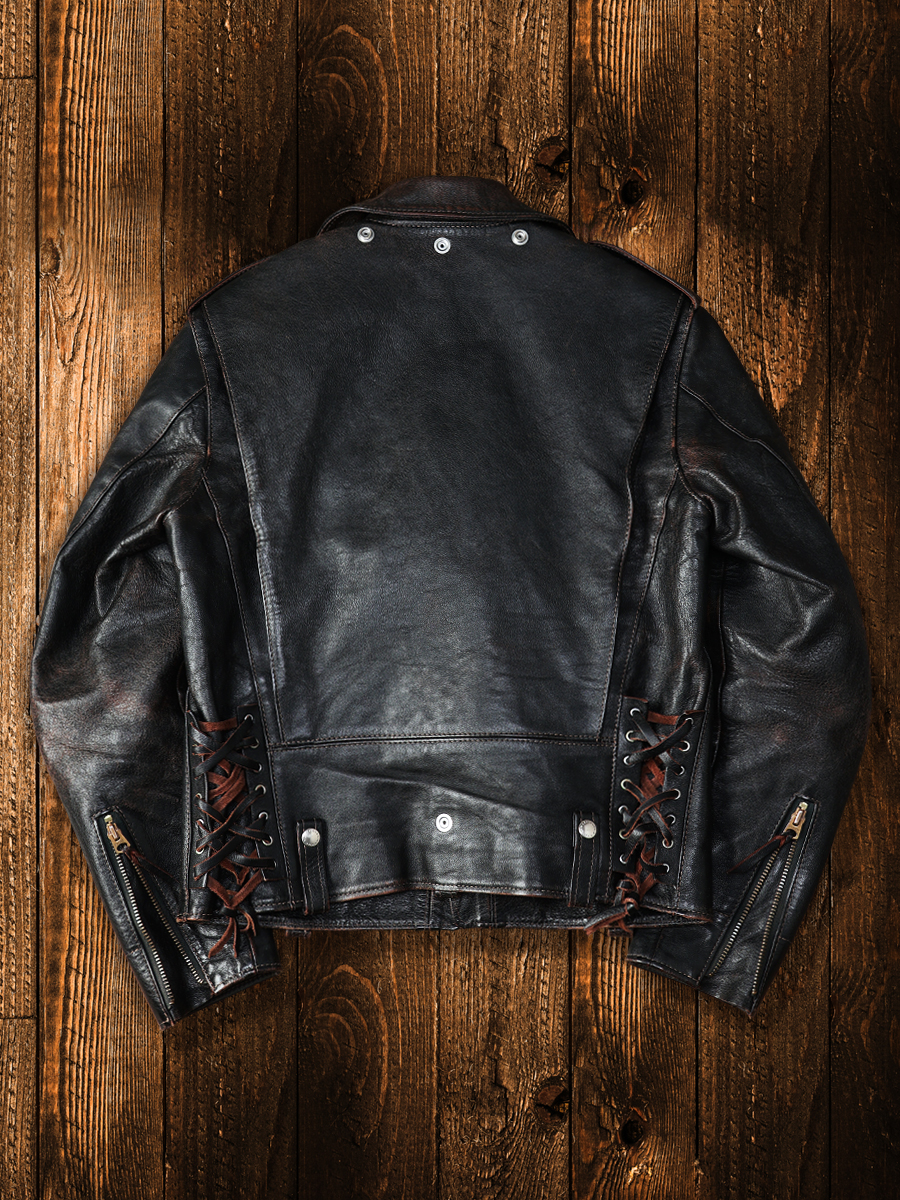
The Flat Head's official Aging Gallery entry for the WRJ-51 — a horsehide double rider's jacket built on the same teacore construction as the FN-LJ-HW004 — worn for approximately 11 years. Photos via flat-head.com.
In The Flat Head's own write-up (translated from Japanese), this jacket is described as a favorite piece worn everywhere — worn in through and through. The owner shaped the collar to sit compact against the chest and customized the side lacing for a tighter, more personal fit. After 11 years, the brand notes that the large ridge-like creases and teacore so characteristic of tannin-tanned horsehide have fully emerged.
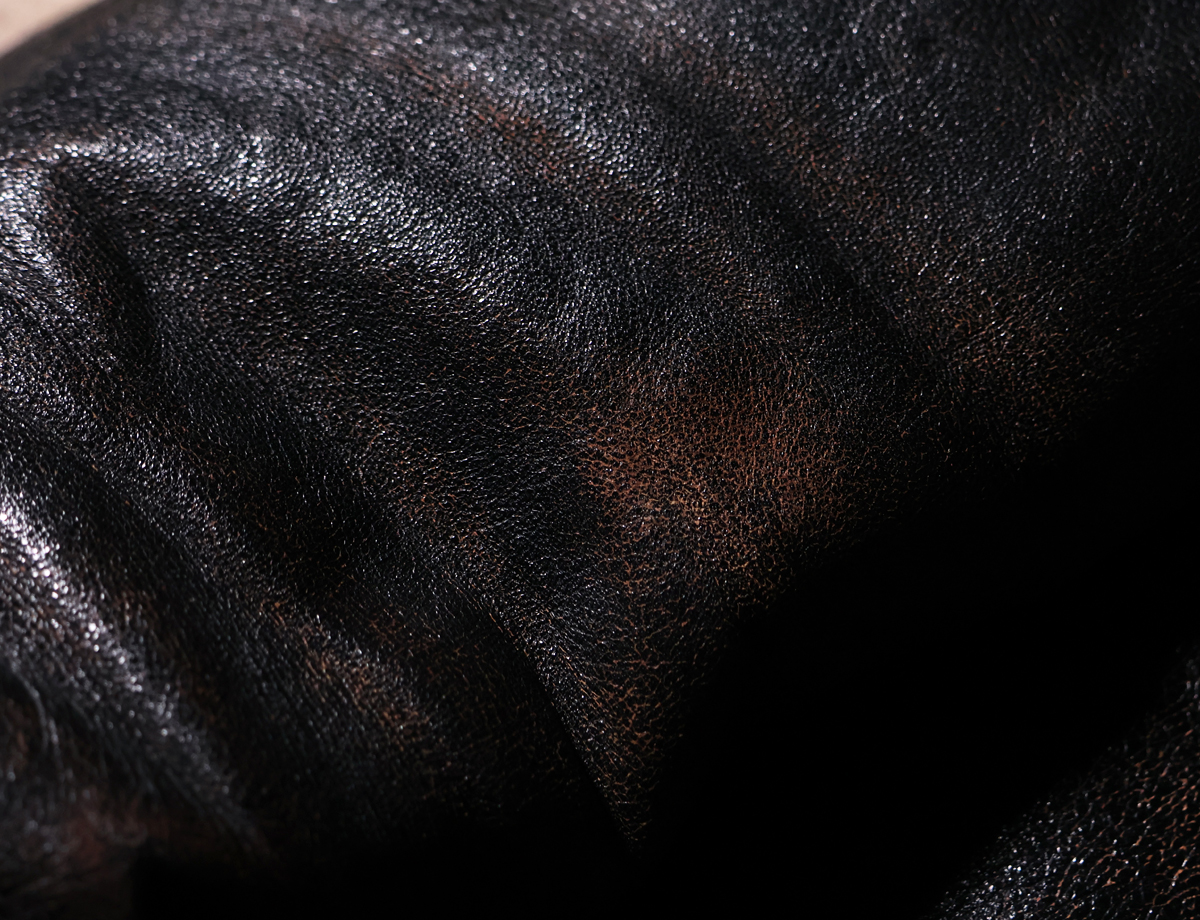 Ridge creases & teacore contrast
Deep creases carved into the sleeve, with teacore emerging clearly along each crease line, giving the wrinkles real depth.
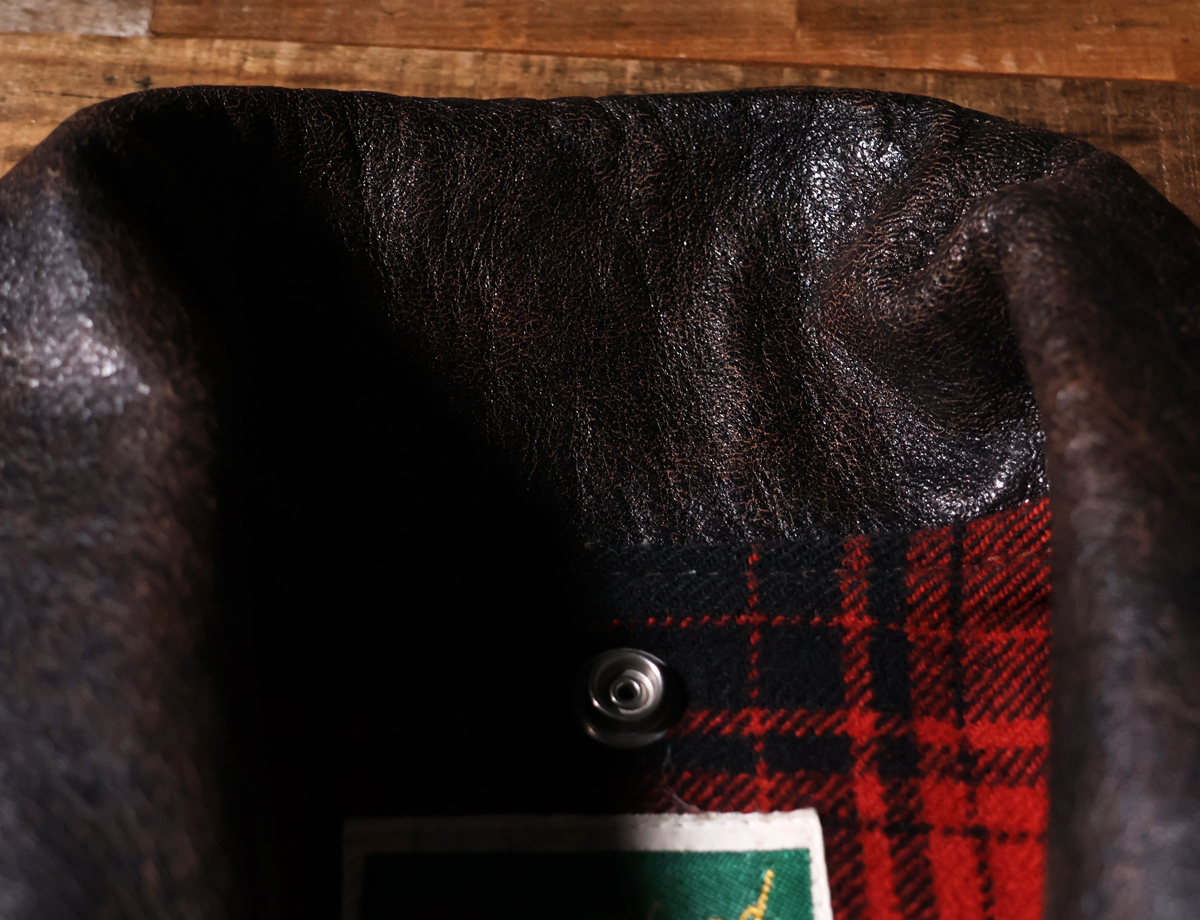 Teacore across the collar
The Flat Head notes this reflects the wearer's own habits — worn with the collar standing up, and touched often enough to fade evenly across the whole surface.
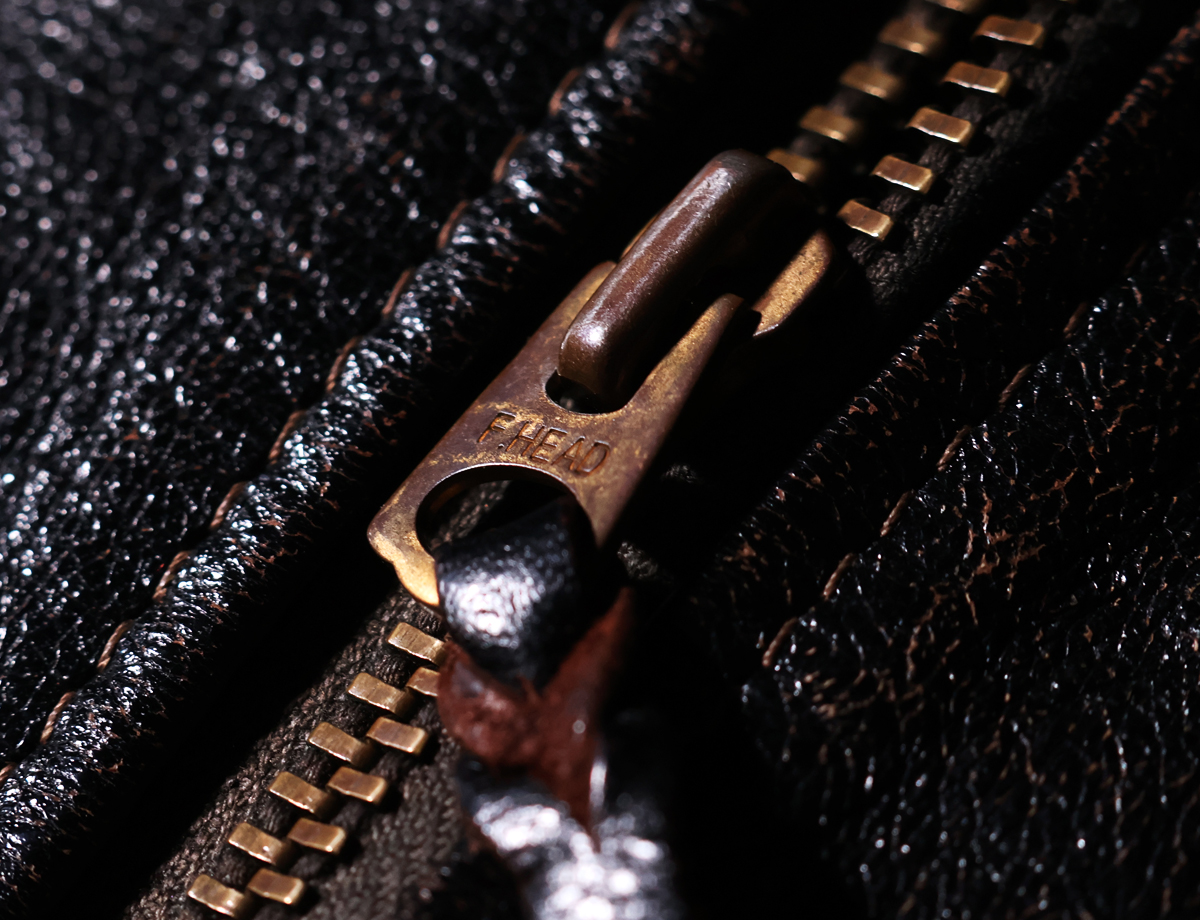 Zipper patina
The brass-toned zipper has shifted to a deep, rust-tinged color that now complements the horsehide's teacore.
 The D-pocket, aged in
Even after over a decade of wear, the D-pocket — the jacket's signature detail — holds its own presence against the aging around it.
That same progression shows up across the wider teacore horsehide world, not just at The Flat Head. Owners of Shinki teacore horsehide pieces from other makers report a broadly similar timeline: sheen developing at contact points in the first 6–12 months, the black finish beginning to flake at elbows, cuffs, and pocket edges by year one to three, and whole panels of brown core exposed along the primary crease lines with three-plus years of heavy wear.
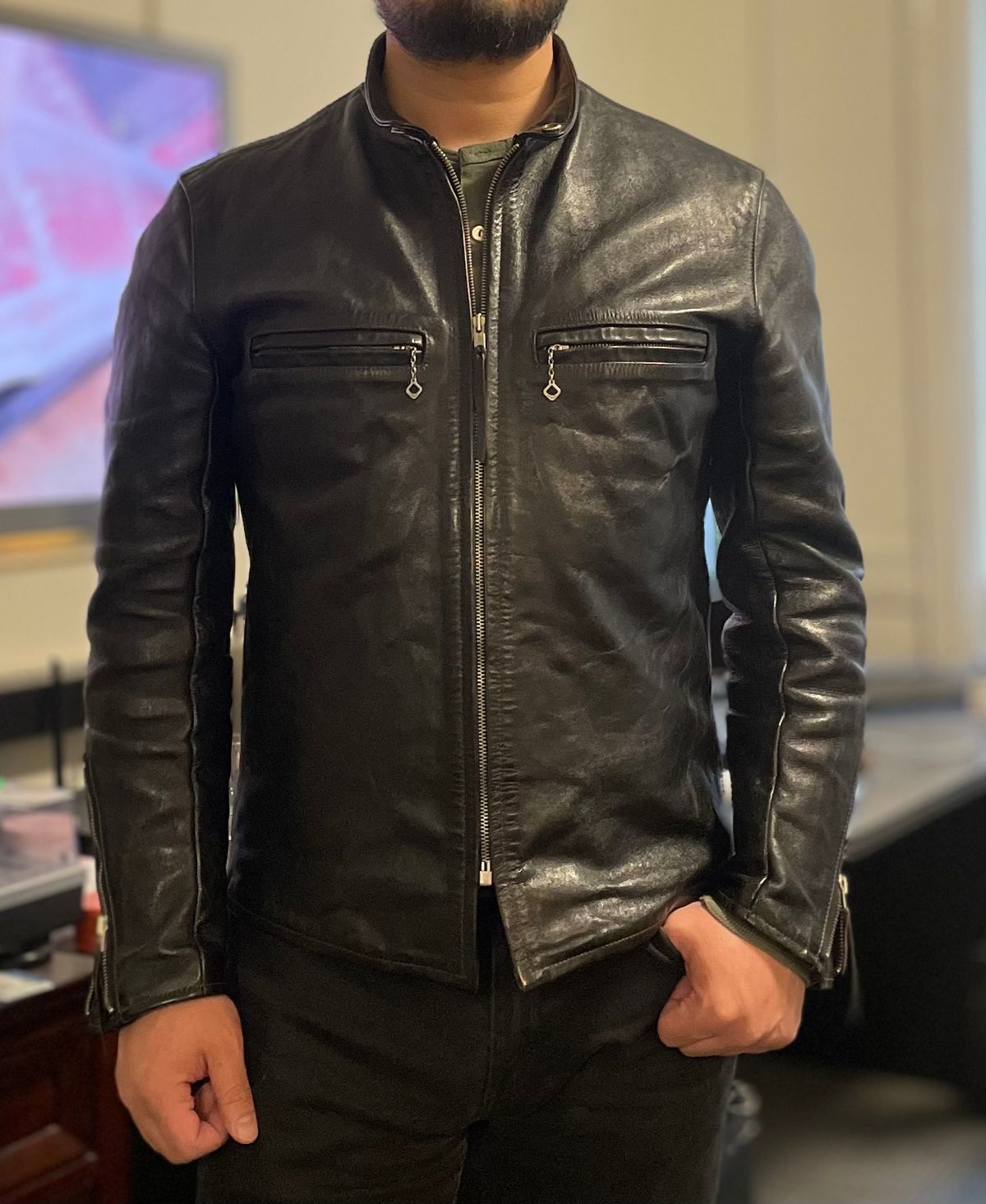
Because the fading is driven entirely by an individual's posture, what they carry, and how a piece moves with their body, this progression is genuinely unique to each wearer — which is exactly why teacore horsehide commands such a devoted following among collectors, whether it's a Flat Head double rider's, a Buco reproduction, or a pair of boots.
Caring for Teacore Horsehide
A few practical notes if you're chasing that fade responsibly rather than by accident: avoid saturating the leather with heavy conditioners, which can soften the finish faster than intended and blur the crisp creasing horsehide is prized for. A light leather balm once or twice a year is usually enough. Let the fade happen through actual wear rather than abrasion — sanding, scraping, or artificially distressing the surface tends to look flat and even, rather than the organic, uneven wear teacore is known for. The Flat Head also offers its own repair and care service, staffed by people who know the product line, through its stores or online. And keep the jacket out of direct, prolonged sun exposure when not being worn, since UV will fade the dark coat evenly rather than in the natural wear pattern that makes teacore so visually interesting.
The Bottom Line
Teacore horsehide isn't special because of any one detail — it's special because every part of the process, from slow vegetable tanning to a deliberately wear-prone semi-aniline finish, is engineered around the idea that the piece isn't finished when it leaves the factory. The Flat Head's FN-LJ-HW004 is one of the clearest modern examples of that philosophy done right, and the brand's own Aging Gallery is proof of how far it can go with real years on the leather. It belongs to a much wider family of horsehide and teacore leather goods — from Real McCoy's and Himel Bros to Red Wing and Sagara — all built on the same idea: a jacket, or a boot, that's meant to be lived in.
We carry the FN-LJ-HW004 at Private & Co. — you can see the full listing, sizing, and current availability here, or browse the rest of our Flat Head lineup here.


